Loading...
Searching...
No Matches
ChainableConfig.hpp File Reference
Concept and utilities for chainable (decorator/pipeline) configurations. More...
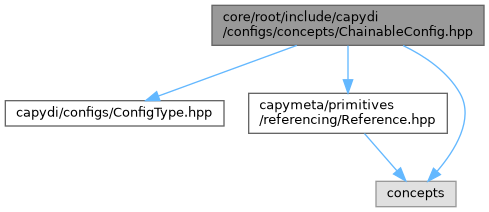
#include "capydi/configs/ConfigType.hpp"#include <capymeta/primitives/referencing/Reference.hpp>#include <concepts>
Include dependency graph for ChainableConfig.hpp:
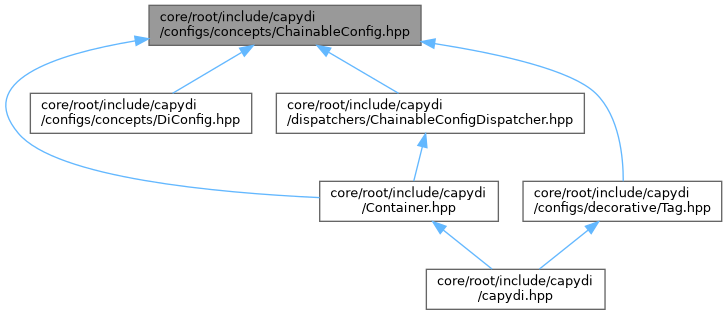
This graph shows which files directly or indirectly include this file:
Go to the source code of this file.
Classes | |
| struct | capy::di::IsChainableConfig< Config > |
| Type trait that checks if a type is a ChainableConfig. More... | |
Namespaces | |
| namespace | capy |
| namespace | capy::di |
Concepts | |
| concept | capy::di::ChainableConfig |
| Concept for configuration objects that transform/decorate dependencies. | |
Typedefs | |
| template<ChainableConfig Config> | |
| using | capy::di::get_related_entity_t = typename Config::RelatedEntity |
| Helper alias to extract the entity type from a ChainableConfig. | |
| template<ChainableConfig Config> | |
| using | capy::di::get_related_keys_pack_t = typename Config::RelatedKeysPack |
| Helper alias to extract the key type from a ChainableConfig. | |
Detailed Description
Concept and utilities for chainable (decorator/pipeline) configurations.
Chainable configurations form a transformation pipeline that is applied to created objects. Common examples include caching layers, validation decorators, logging proxies, and security wrappers. The framework supports arbitrary chains of such decorators applied in sequence after the initial object creation.